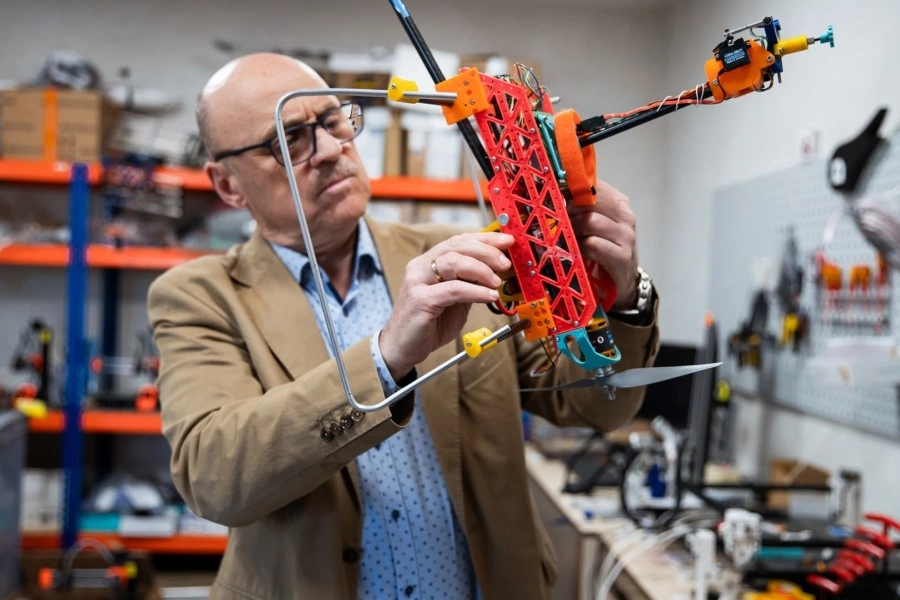

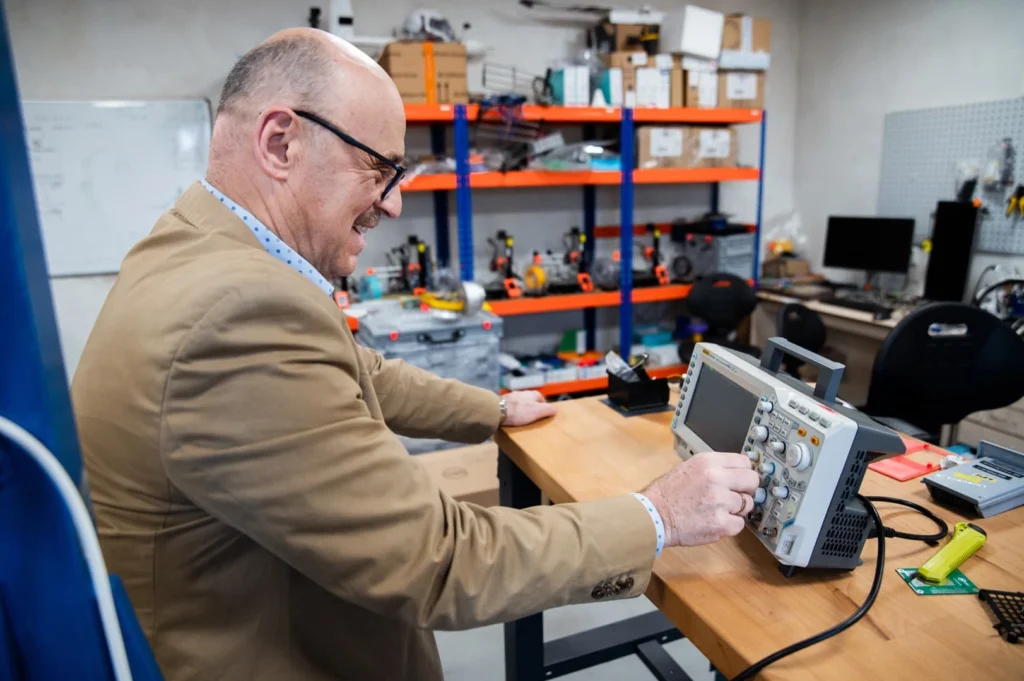
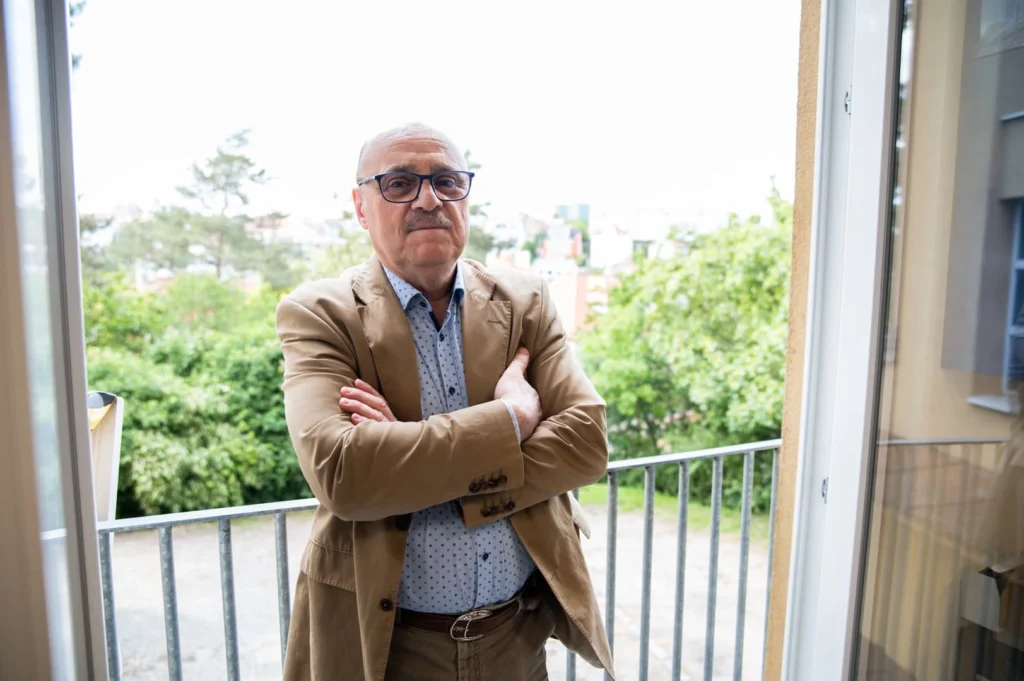
Born in Ukraine, Alexander Kostinskiy built his scientific career in Russia. However, following the Russian invasion of Ukraine, he was forced to choose between imprisonment and emigration. Today, thanks to the support of the MERIT programme run by the Central Bohemian Innovation Centre, he works at the Nuclear Physics Institute of the Czech Academy of Sciences, where he and his colleagues study lightning discharges. In this interview, he explains why thunderclouds are fascinating natural particle accelerators, how researchers collect terabytes of field data, and why science in an isolated Russia poses a global threat.
Why did you choose the Czech Republic and the MERIT programme after leaving Russia?
The programme gave me a unique opportunity to collaborate with Czech colleagues and leading experts in high-energy atmospheric physics, with whom we had already made significant plans for cooperation before the war in Ukraine. The war seemed to put an end to those plans forever. However, when I learned about the programme, I was delighted to discover that there was a chance to return to the ideas that Ondřej Ploc from the Nuclear Physics Institute of the Czech Academy of Sciences and I had discussed several years earlier.
What is the main focus of your research within the programme?
Our research focuses on thunderclouds as natural particle accelerators. Our primary objective is to detect high-energy particles—electrons and X-rays—that are produced during the rapid upward propagation of positive lightning leaders into storm clouds. This phenomenon has never been detected before, making it a major scientific challenge.
We chose wind turbines as the objects for generating these upward positive leaders during thunderstorms because they are 10 to 30 times more effective at initiating lightning than stationary structures of the same height.
In close collaboration with the LOFAR radio telescope team, we also plan to use lightning discharges from wind turbines to calibrate the telescope’s antennas. This will improve the identification of different types of intra-cloud lightning discharges and advance our understanding of how lightning is initiated inside storm clouds.
Does your research have practical applications?
Thunderstorms and lightning are among the most common natural hazards. Failures of high-voltage power lines, wildfires, wind shear that can cause aircraft to lose control during take-off and landing, lightning strikes on aircraft, and failures of wind turbines all depend on how well we understand the processes occurring inside thunderclouds.
Paradoxically, scientists often have a better understanding of what happened during the first moments of the Universe than of what happens during the very first moments of a lightning strike, even though these occur directly above our heads about one hundred times every second.
Is the project progressing according to plan? Have your data revealed anything unexpected?
Yes, it is progressing well. At the moment, we are mainly preparing and fine-tuning our equipment because we are not yet able to conduct joint experiments with the LOFAR team. The radio telescope is currently undergoing a major upgrade, and we hope it will return to full operation this autumn.
We obtained unexpected results through collaboration with Ludwig Maximilian University of Munich and the Czech Technical University. Using high-speed, highly sensitive instruments, we detected an order of magnitude more electrical discharges in volcanic ash than our German colleagues. These instruments could eventually be used for the remote monitoring of volcanoes. Small electrical discharges in thunderclouds, volcanic ash, snowstorms, dust storms, and tornadoes all share the same fundamental physical principles. These results also demonstrated that our equipment is fully prepared for the upcoming experiments with the LOFAR team in the Netherlands.
Another pleasant surprise and challenge was the opportunity to help my colleagues calibrate dosimetry instruments at CERN’s North Area. I hope I made a small contribution to preparing the equipment for the Czech astronaut whose mission could potentially take place next year. Precise calibration of these dosimetry devices will also help us measure the energetic particles generated during thunderstorms and lightning discharges from wind turbine blades.
A dedicated team of enthusiasts willing to chase lightning anytime, anywhere
What kind of equipment do you use to simulate thunderstorms?
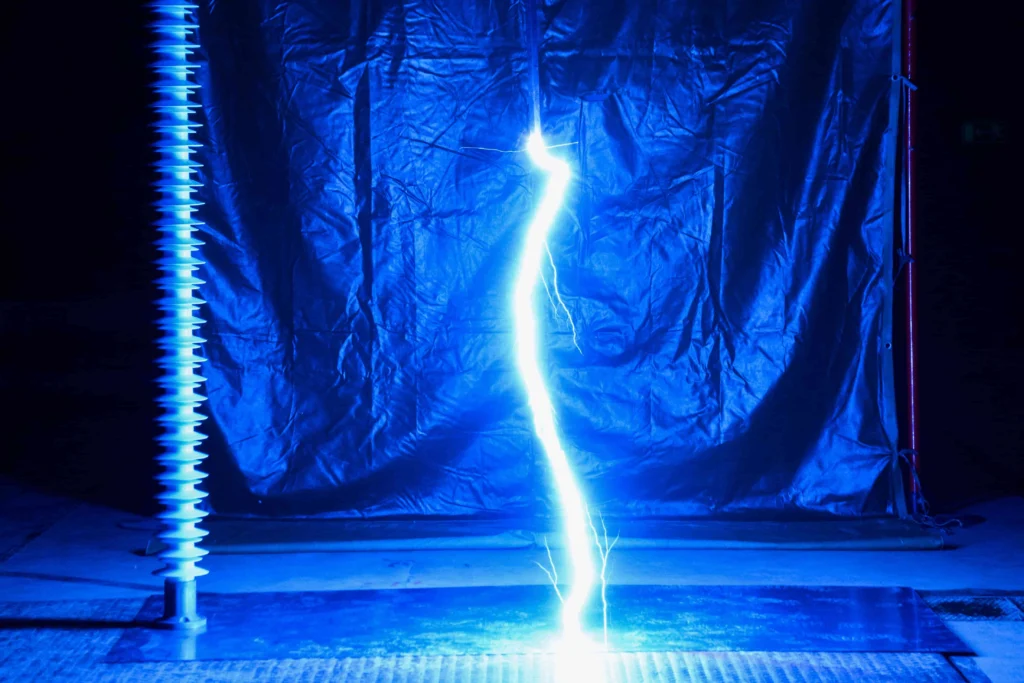
To model long electrical sparks in the laboratory, my colleagues from the Czech Technical University and I use large high-voltage Marx generators located in Prague’s Běchovice district. These are massive facilities owned by the private company EGU HV Laboratory, and researchers and engineers from various institutions can rent them for testing and research purposes.
What kind of equipment do you need in the field, and how does field research work?
Our institute operates a specialized vehicle equipped with instruments for lightning research. It carries a variety of radio antennas, electric field sensors, wind and precipitation gauges, as well as high-speed cameras capable of recording up to 1,000 frames per second using all-sky optics. For the current MERIT project, we also use photomultiplier tubes with nanosecond time resolution and additional ultra-high-speed cameras capable of capturing hundreds of thousands of frames per second.
During thunderstorms, we position ourselves near wind turbines to record electrical discharges originating from the turbine blades. At the same time, the LOFAR team tracks the trajectories of lightning channels both around the wind turbines and inside the storm clouds. For a single lightning strike, we collect approximately one million radio signal data points with a temporal resolution of about 100 nanoseconds and a spatial resolution of 10 metres or better. These data points are distributed across an atmospheric volume covering roughly one hundred square kilometres.
Where do you store such enormous amounts of data?
We have servers at the Institute of Physics in Lublin. Although they are substantial, they are often insufficient for experimental datasets. The LOFAR project operates much larger facilities, consisting of nearly 20,000 antennas, each with enormous data storage capacity. To reduce the volume of field data, the recordings undergo post-processing before being archived. The processed field data are stored on servers at the Nuclear Physics Institute of the Czech Academy of Sciences.
How do you predict thunderstorms, and how often do you go into the field?
Our group uses meteorological models, such as the Czech application Windy, to chase thunderstorms. We have vehicles equipped with antennas and other instruments developed within the CRREAT (Research Centre of Cosmic Rays and Radiation Events in the Atmosphere) project, which was funded by the European Union until 2023. Using Windy, we predict where thunderstorms will occur and then drive to those locations. We head out quite frequently, often outside regular working hours or even at night—unfortunately, thunderstorms do not follow office schedules. That is why it is so important to have a team of dedicated enthusiasts willing to collect data whenever conditions require it. They deserve enormous credit for their commitment.
We also use permanently installed instruments, likewise acquired through the CRREAT project, located mainly at mountain observatories with which we collaborate. In the Czech Republic, this includes Milešovka, but we also work with high-altitude observatories across Europe, including Lomnický štít in Slovakia, Zugspitze in Germany, Jungfraujoch in Switzerland, Musala in Bulgaria, and Aragats in Armenia.
Are your field campaigns abroad funded by the MERIT programme, or do you need to secure additional funding?
The MERIT programme is specifically designed to support projects that benefit both the host institution, where the researcher is primarily employed, and the receiving organisation where the researcher undertakes secondments or research stays. However, it is important to distinguish these international research visits from field campaigns aimed at measuring radiation phenomena associated with thunderstorms. For these field expeditions, as well as for maintaining and upgrading our instrumentation, we have to seek additional sources of funding. We also make use of infrastructure developed through the CRREAT project, which I consider an excellent example of synergy and a natural continuation of previous and ongoing research activities at the Nuclear Physics Institute.
You left Russia in 2022. Why did you make that decision, especially considering that you already had your own research group there?
At the time of Russia’s full-scale invasion of Ukraine, I held a permanent position as Head of the Laboratory of Hazardous Geophysical Phenomena. I truly had a job that I loved. In reality, however, I had no choice between staying in Russia and leaving because, although I had established my scientific career in Moscow, I was born and raised in Ukraine in a Jewish family.
Since the annexation of Crimea in 2014, I had publicly protested against Russia’s interference in Ukrainian affairs. After repressive laws were introduced in February 2022, however, I was forced to choose between imprisonment and emigration. I decided to leave Russia so that I could continue to speak openly against the regime, even though I had no idea what the future would hold for me and my family. Ultimately, my path to freedom of speech led me to Israel.
Was Israel your only option?
In the spring of 2022, Russians who opposed the invasion of Ukraine had almost no opportunities to legalise their status abroad, except for those with Jewish ancestry. At that time, Israel introduced an accelerated repatriation programme for Jews from Ukraine and Russia. I moved to Israel and was immediately offered a temporary position for immigrant scientists at the Technion, one of the world’s leading technological universities. My work at the Technion’s Faculty of Physics became a real lifeline for me, both personally and professionally.
You then moved from Israel to the Czech Republic. How would you compare the scientific environments of these three countries? Are there significant differences?
The scientific communities in the Czech Republic, Israel, and Russia all share a passion for advancing knowledge over bureaucracy. However, they are shaped by very different traditions and realities.
In the Czech Republic, a country with a strong academic and engineering heritage and an open scientific environment, I greatly appreciate my colleagues at the Nuclear Physics Institute. They value elegance in scientific thinking and genuine research results, supported by European standards and close collaboration with neighbouring countries.
Israeli science, by contrast, is strongly influenced by the country’s constant security challenges. It is highly focused on survival, practical applications in security and healthcare, and maintains strong competitive links with the United States.
Russian science, after a period of international integration and growth supported by oil revenues, still possesses enormous human potential. However, as a consequence of the current war, it has become increasingly isolated from the West and has redirected much of its scientific cooperation towards China.
Do you plan to stay in the Czech Republic after your MERIT fellowship ends?
Yes, I would very much like to continue living and working in the Czech Republic after my MERIT grant ends. I believe I can contribute not only through academic research but also by helping transform our scientific discoveries into practical applications. To that end, I have already begun consulting experts in the commercialisation of basic research and the creation of deep-tech start-ups.
Russians Who Communicate with Foreigners Are in Real Danger
Have you ever experienced any unpleasant situations because you are Russian?
No. I have never had a negative experience—neither at the Nuclear Physics Institute, nor in everyday life, nor when dealing with Czech authorities. Everywhere I go, I meet polite and friendly people. The culture of communication in the Czech Republic is very close to my heart, and I have tremendous respect for it.
The only exception has been Czech banks, which, due to their internal policies, restrict services for holders of Russian passports regardless of any additional citizenship or long-term residence in another country.
Are you still in contact with your former colleagues in Russia?
No. Some of them have accepted the war and support the authoritarian regime, making communication impossible for me. Others share my values completely, but maintaining contact with me could put them in danger.
Today’s Russia carries out severe repression against those who oppose the authorities—and even against people who simply maintain contact with those who have left the country and openly oppose the regime. Individuals can be labelled as “foreign agents” or as people “under foreign influence.” Such accusations may result in criminal prosecution and lengthy prison sentences.
How does Russian science function today? Is there still any degree of academic freedom, and can Russian scientists collaborate internationally?
The United States and the European Union have imposed restrictions on scientific cooperation with Russian researchers. For many of my former colleagues, this has been a personal tragedy.
At the same time, the Russian authorities persecute those who attempt to maintain ties with Western scientific institutions. The security services fabricate charges against such individuals and imprison them for many years.
The walls separating Russian science from the West are therefore being built from both sides. Russia’s new scientific partners have become China, Iran, North Korea, and several Arab countries. Given Russia’s still considerable scientific capabilities—particularly in military-related fields—I believe this represents a significant global threat.
Given that you study thunderstorms, have you ever been injured during your research?
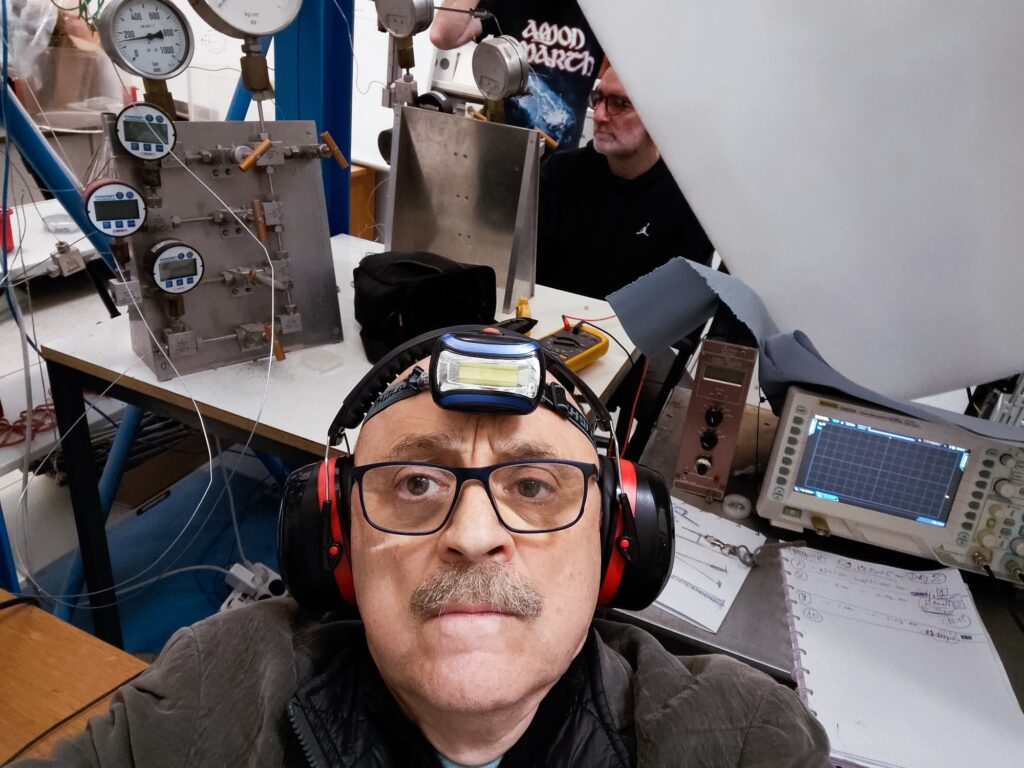
I study the physics of hazardous natural phenomena, so injuries are an occupational risk for anyone working in this field. I always try to be careful and follow standard safety procedures. That is not always possible, but fortunately I have not suffered any serious injuries so far.
Is your family here with you?
My wife works in the Czech Republic within the Civil Society programme as a science journalist and leads the T-invariant project, which has brought together anti-war scientists since April 2022 while documenting repression and the militarisation of Russian science.
Our adult sons—one a leading software specialist living in Munich and the other a graduate in renewable energy based in Austria—share European values and left Russia even before the war began. Because they hold Russian passports, they are not eligible for work permits in the Czech Republic, which prevents us from living together in the same country. Nevertheless, we are grateful that the proximity of Prague, Munich, and Vienna allows us to see one another regularly. For many families separated by current events, even that is impossible.
How satisfied are you with life in the Czech Republic?
The word satisfied does not even come close to describing how happy I am in the Czech Republic. Even after travelling across half the world, I still believe that Prague is the best city on Earth.
I am fascinated by the history of every house and bridge around me. I study Czech cinema and visit places associated with great figures such as Albert Einstein with genuine admiration. My passion for Czech culture and history has become such a family joke that my children tease me by saying they would have to pass an exam in Czech history before I would let them visit us in Prague.