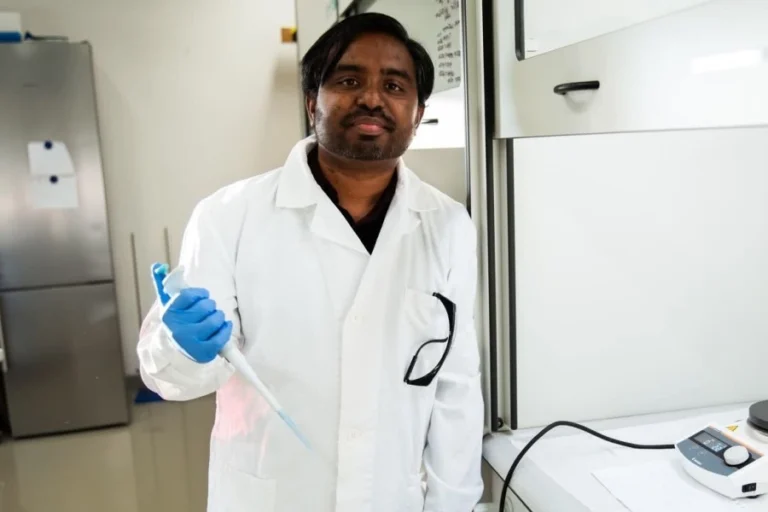


Cameroonian microbiologist Rufin Marie Toghueo Kouipou is part of the MERIT programme at the Central Bohemian Innovation Centre and works at the Institute of Microbiology of the Czech Academy of Sciences and at the BIOCEV centre. In this interview, he talks about his research in one of today’s most pressing medical topics — antibiotic resistance and new medicines — and about what brought him to the Czech Republic.
In your research, you focus on antibiotic resistance. Why is it a global issue?
Antibiotic resistance is truly a global problem. Every year, statistics are published showing how the number of people dying from infections caused by bacteria resistant to available drugs is increasing. Resistance knows no borders — it affects developing countries as well as the most advanced ones. That is exactly why I ask where new effective compounds can come from.
My strategy is simple, though scientifically demanding: to go where people have not looked much yet and search for microorganisms in extreme or poorly explored environments. Most antibiotics we use today were discovered thanks to microorganisms. So it is logical to assume that in unexplored ecological niches there may be organisms producing new, as yet unknown compounds.
That is why I collected a large number of samples in Cameroon from various environments. In the lab, I then analyse them in two ways: through metabolomics, which shows what substances microorganisms produce, and genomics, which reveals what biosynthetic pathways they have available. These approaches complement each other and together make it possible to identify organisms or compounds with the potential to become the basis for a new drug.

What personally drew you to the topic of antibiotic resistance?
During my PhD studies in Cameroon, I worked with microorganisms, specifically fungi living in symbiosis with plants. Thanks to research stays in India and Spain, I had the opportunity to learn different scientific approaches and at the same time gain the necessary perspective.
I realised two things. First, that research into antibiotic resistance is scientifically extremely fascinating — it is a challenge that forces you to think constantly and look for new paths. And second, that it has enormous societal significance. You are not creating abstract knowledge, but something that can directly save lives.
When the MERIT programme appeared, I was not sure whether my project would even fit the call. I consulted it with the programme coordinators and with my current supervisor at the Institute of Microbiology of the Czech Academy of Sciences. Their support encouraged me, and in the end I applied — successfully.
And I admit it also meant choosing among several very prestigious options. I had an offer from Brazil and also a JSPS fellowship (note: Japan Society for the Promotion of Science) to Japan. Nevertheless, I chose the Czech Republic.
What would you like to achieve during the 30-month grant period? After all, developing a new antibiotic is a long-distance run.
It certainly is. Discovering new antibiotics is not a discipline that can be completed in a year or two. Still, I hope that within this time I will achieve at least one concrete, promising result that will become a basis for further research — for example in collaboration with industry.
That result could take the form of a new molecule that could be chemically modified and tested as a candidate for a new drug. Or it could be the microorganism itself that produces the compound. Both options are very valuable. Microorganisms can be further engineered to produce the compound in larger quantities or in a more effective form. And if you discover one truly interesting organism, it often suggests that there may be others in the same environment.
This kind of project is a typical example of what is called “high risk, high reward”. For a long time you may find nothing at all — but if you hit one good result, it can mean a breakthrough.
Even children already know the term “antibiotic resistance”. How serious do you think the problem is?
It is a very serious threat. And it is global. There are many scientific directions for tackling the problem: epidemiology, molecular biology, genomics, the development of new diagnostics… I focus on discovering new compounds, but that is only one piece of a larger puzzle. Every approach has its place.
In my research, I test how new compounds act against the most resistant bacteria we have in the laboratory. It is a strategic choice — if a compound can work against these “worst” microorganisms, there is a chance that it will be clinically relevant.
How do you see current developments in the field of antibiotic resistance?
I see several interesting shifts. One of them is certainly growing funding. Over the past five years, the number of grants dedicated to this topic has increased significantly. Antimicrobial resistance has moved to the centre of attention for political leaders, major foundations and non-profit organisations. And that is crucial, because without funding, science cannot move forward.
The second area is rapid technological development. Modern genomics, which was far less accessible ten years ago than it is today, now enables us to track resistance genes in real time, map the spread of resistant strains and quickly test the effectiveness of new compounds. All of this speeds up and improves research.
But something else has changed too — public awareness. A few years ago, antibiotic resistance was not a topic you would commonly hear about in the media. Now, even children who come to events at our Institute of Microbiology of the Czech Academy of Sciences already know what the term means. And that may be a bigger breakthrough than it seems. If the public understands the urgency of the problem, politicians — who decide where research funding goes — respond as well.

What are the biggest obstacles in antibiotic resistance research today?
There are several. One of the most significant lies outside science itself — it is the political and regulatory environment shaped by state institutions. Between what scientists do in the lab and the bureaucratic processes and regulations they must follow, there is sometimes an enormous gap. Developing a new drug can take fifteen to thirty years and is burdened with a great deal of administration that often does not match the urgency of the problem we are trying to solve. It is a structure that significantly slows things down.
The second group of obstacles is the biology of microorganisms themselves. Bacteria have an incredible ability to adapt and develop new resistance mechanisms. Even though we know a lot about this process, there are still areas we do not fully understand. When you try to find a new drug, you run into the fact that the organism you wanted to “defeat” has meanwhile found another way to defend itself. And that is a major scientific and technological challenge.
The MERIT programme offers real support for a long-term project
You said you had several other offers besides MERIT. What made MERIT appealing enough for you to choose the Czech Republic?
The biggest difference was that MERIT offers real support for a long-term project. In a postdoctoral career, the biggest problem is the constant cycle of short-term contracts. Often you get a year or two, complete part of the work — and then you have to start again. A new grant, a new place, a new team. It is demanding not only professionally but also personally.
MERIT is different in this respect. It gives you the opportunity to truly develop a project and also creates space for it to continue beyond the fellowship. My current supervisor, Zdeněk Kameník, thinks in a similar way. We both know that developing a new bioactive molecule cannot be finished in 30 months. That is why we are already planning next steps and looking for follow-up funding.
So MERIT offered me not only financial support, but something much more important: a perspective. And that is what tipped the balance even against more prestigious options.
What impressions do you have of the Czech scientific environment? You have worked in several countries — do you see differences?
Yes — several, and mostly positive.
First of all, I was surprised by the strong focus on the quality of science itself. In some countries, academic hierarchy is pronounced and the opinion of a postdoc or a young researcher is not always seen as equal. At the Institute of Microbiology of the Czech Academy of Sciences, I experienced the opposite. It does not matter whether you are a student, postdoc or professor — if you have a good idea or a relevant argument, you simply present it. That is extremely liberating and motivating.
The second thing is the openness of the scientific community. Seminars, presentations and internal meetings happen constantly at the institute. But beyond that, I was surprised by how easy it is to walk into the lab next door, ask for advice, borrow an instrument, or simply discuss a problem with someone who sees it differently. In other institutions where I worked, that was not the norm at all.
This openness to sharing means that knowledge and experience “move around”, and you learn much faster. For an ambitious project like developing antibacterial molecules, that is a huge advantage.
Have you also encountered any obstacles — scientific or cultural?
Scientifically, I can say my experience has been very good. But that does not mean everything was easy from the start. One issue is the language barrier. Not everyone in the Czech Republic speaks English, and for foreigners that can sometimes make everyday communication more difficult.
And then there is a topic that is not easy, but I think it is right to speak about it openly. I have encountered racist behaviour several times. It was not frequent, but it happened — once even quite strongly. It was not a pleasant experience. What mattered to me a lot, though, was the reaction of people in my work environment. When I shared the situation with my colleagues, they responded with great empathy and support, which helped a lot.
I think it is important for anyone who comes to work in a new country to feel that they can speak openly about such things. And I am fortunate to have that kind of environment in my lab.

What cultural differences surprised you most in the Czech Republic?
I probably will not be original, but the Czech Republic is a country where people can seem rather reserved at first glance. They are not the kind of people who will hug you right away or start chatting with you in the street. They may come across as cold or closed off.
On the other hand — and I have to emphasise this — I very much appreciate Czech directness. When Czechs mean something, they usually say it. They do not tend to hide disagreement or unpleasant messages behind a polite façade. In the Czech Republic, you usually learn someone’s real opinion immediately. And personally, that suits me. It makes communication easier and simplifies life.
Let’s touch on collaboration with industry, because antibiotic resistance is a field where academia and applied research can potentially overlap. How do you see cooperation between the private and academic sectors?
I have not personally reached that stage of research yet, but from what I see in my field, it is clear that collaboration between academia and industry in antibiotics usually does not arise from a paper or an interesting idea. Industry needs a concrete result: a molecule, a method, a test — something with practical potential. Once a researcher has such an output, things begin to move faster. Suddenly companies, investors or foundations become interested in the project.
There is also another type of collaboration: outsourcing. In some cases, it is far more advantageous to have certain analyses carried out by an external company that has specialised equipment and processes. If you know that a specific test would take you half a year under academic conditions, while a company can do it in a week, it is a logical decision. It saves time, money and energy.
In the future, I would of course like to reach the point where it is realistic to start thinking about industry collaboration. And MERIT gives me the space to build the foundation that can lead to that stage.
Looking a bit further ahead — where would you like to take your research?
My goal is simple and at the same time long-term: I would like the project not to remain only at the academic level. Discovering new antibiotics is, of course, a marathon, not a sprint. It requires years of work, repeated testing and a great deal of patience.
If I manage to identify a microorganism or a compound with real potential, it would be the start of a path that could eventually lead to practical application. And that is a very strong motivation for me personally.
I would also like the research to one day contribute to the regions I come from. Cameroon — and many parts of Africa in general — is full of ecological environments that almost no one has explored yet. I believe many bioactive compounds are hidden there, waiting to be discovered. If one day it were possible to connect the research here in the Czech Republic with the potential of those environments, it would be a great personal fulfilment for me.