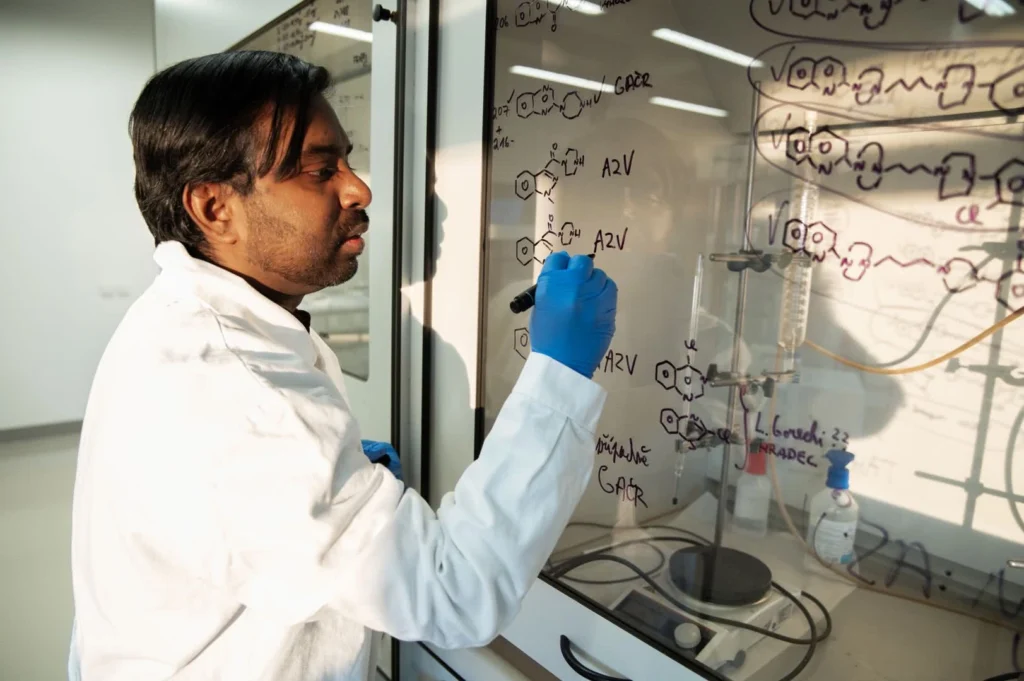
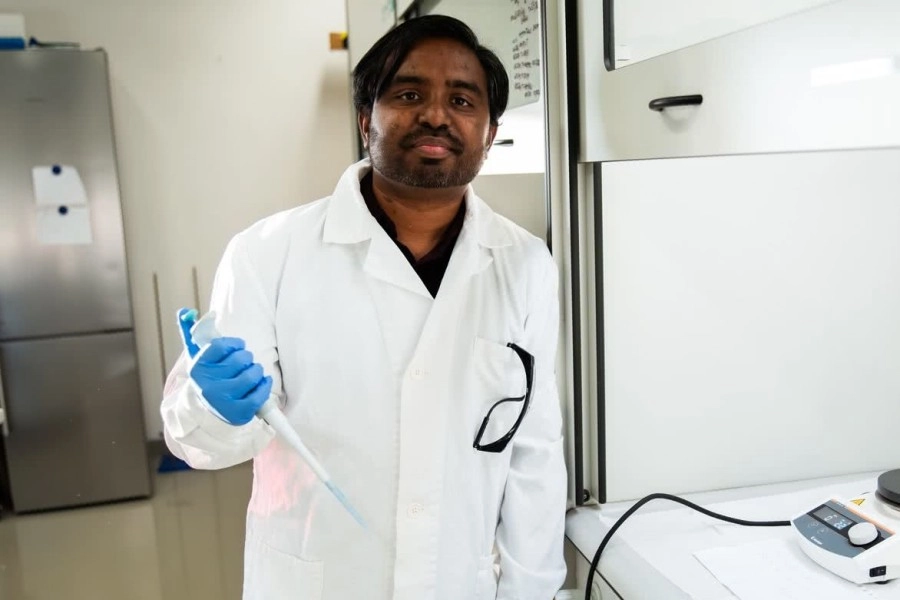
Postdoctoral researcher at the National Institute of Mental Health, Jaison Jeevanandam, would like to one day see his nasal spray on the market. The spray would deliver a drug based on magnesium oxide nanoparticles directly to the brain, where it would combat insulin resistance. This condition has serious consequences, including the development of Alzheimer’s disease. Through the MERIT program, he connects nanomedicine with artificial intelligence in Klecany.
In your research, you mention the concept of insulin resistance in the brain. What does that mean?
Insulin resistance is a condition in which cells cannot absorb insulin from the body. Sugar then remains in the bloodstream instead of entering the cells, damaging blood vessels and causing cardiovascular diseases, ultimately leading to the well-known condition diabetes mellitus. This condition can also occur in the brain. The presence of insulin-resistant cells in the brain can lead to dementia or memory loss. This is further associated with the development of various neurodegenerative diseases, such as Alzheimer’s disease or Parkinson’s disease.
Currently, diabetes is treated by administering insulin injections, but this non-targeted treatment often leads to obesity or cognitive problems, such as learning difficulties or memory loss. The solution is to target the drug precisely to the area of the brain where it is needed. For this, I use specially modified nanoparticles.
How exactly do you work with nanoparticles?
Nanoparticles are usually used as carriers of active substances, in the case of diabetes as carriers of insulin. However, during my doctoral studies, I developed magnesium oxide nanoparticles that themselves act as the active substance, enhancing the effect of magnesium and reversing insulin resistance in cells without any side effects. Later, I attempted to formulate magnesium oxide nanoparticles with biopolymers to improve their effectiveness through sustained release. However, these biopolymer formulations did not perform very well.
Currently, I am working on a more complex formulation using dendrimers and aptamers. Aptamers are nucleotide sequences that target a specific protein in the hypothalamus of the brain. In insulin resistance, it is necessary to release this protein, which can be achieved using aptamers.
How do you plan to administer the drug?
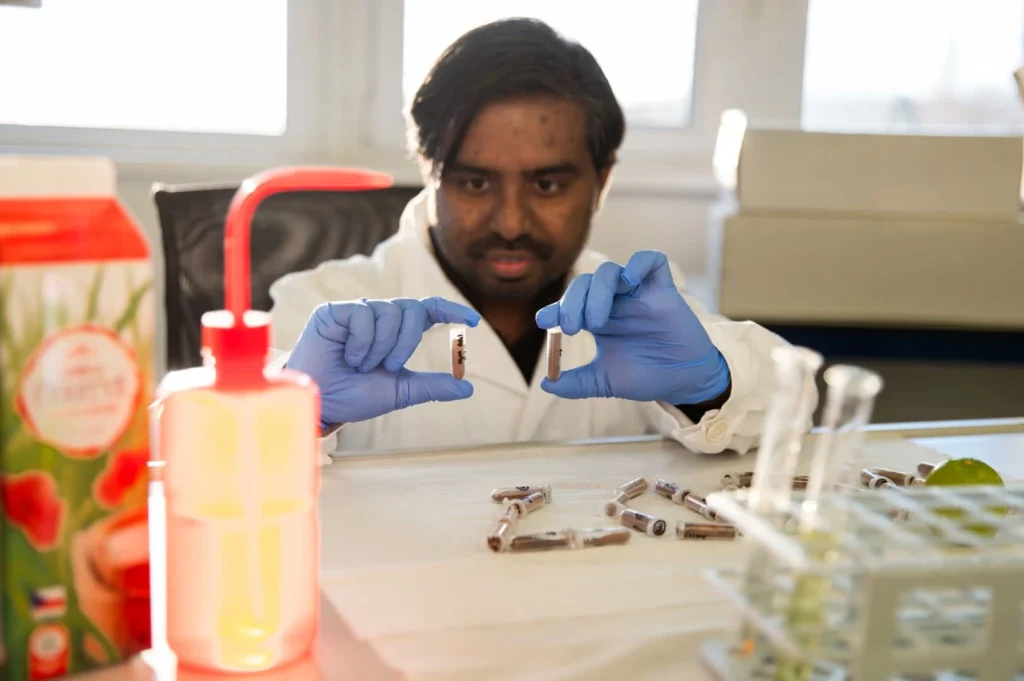
We are working on developing a non-invasive delivery method using a nasal spray. We have managed to target the active substance directly to a specific part of the brain. Insulin from the body can then enter the cells in that part of the brain, reducing blood glucose levels. The active substance is released in the hypothalamus for approximately 24 hours. It may sound simple, but targeting is the most difficult and crucial part of the entire research. We combine animal experiments with the use of AI
How do you test the effectiveness of your method?
In standard practice, the active substance is administered to animals, most often mice, and researchers observe whether behavioral changes occur or whether the disease develops or is cured. However, our approach is different. We administer the drug to the animal and then collect MRI scans. In analyzing these, we use artificial intelligence tools that allow us to predict the minimum dose required to reverse insulin resistance. I came up with this idea while reading scientific articles where artificial intelligence was used instead of laboratory animals. This is very important for our research and for me personally.
What else makes your research innovative?
The goal of the project I am currently working on within the MERIT program is to develop an AI-based mobile application. How would it work in practice? You would visit a doctor, undergo an MRI scan, upload it to your phone, and the application would determine the specific dosage and duration for using the spray. The application would be connected to your doctor. This is part of so-called telemedicine of the future.
Do you collaborate with other institutions?
Since the project is multidisciplinary, I need experts from various fields. I collaborate with four institutions through secondments. The Department of Cybernetics at the Czech Technical University in Prague helps me develop machine learning algorithms and AI components; the Madeira Chemistry Research Centre in Portugal (CQM) characterizes modified nanoparticles; the University of Barcelona in Spain develops the intranasal spray; and the industrial partner Detect.or in Italy optimizes aerosol concentration in the nasal spray. Animal studies are handled by my colleague at the National Institute of Mental Health (NUDZ), and MRI scans are performed in collaboration with the Institute for Clinical and Experimental Medicine (IKEM).
I am also trying to establish collaboration with the University of Pardubice to characterize nanoparticles, with the Department of Biochemistry at Charles University to involve bachelor’s students in exploring other biomedical applications of MgO nanoparticles, and with the Institute of Physics of the Czech Academy of Sciences to characterize purified nanoparticles and evaluate their size using dynamic light scattering.
Where did you work before coming to the Czech Republic?
I worked at a university in Madeira. Since Madeira is an island, it was difficult to collaborate with institutions on mainland Portugal or in other European countries. I would like to apply for an ERC grant in the future and wanted to collaborate with scientists from the European Union. Therefore, I wanted to move somewhere in Central Europe, which I was able to do thanks to the MERIT fellowship that I learned about from my former supervisor.
What specifically brought you to the National Institute of Mental Health (NUDZ)?
In my previous research in Madeira, and before that in Malaysia, I focused only on treating cardiovascular diseases caused by diabetes. I wanted to move forward and connect my research with neuroscience, so I began studying nanomedicine, specifically the treatment of diabetes in the brain. I wanted to create something new—a nanomolecular robot capable of monitoring a specific area of the brain and then releasing nanoparticles that can reverse insulin resistance and subsequently treat dementia. This idea can be realized at NUDZ.
I learned about the institute through a conference where I met my future colleague from NUDZ. It was important for me that high-quality animal studies can be conducted there. Another motivation was that experts studying neurodegenerative diseases such as schizophrenia, Parkinson’s disease, and Alzheimer’s disease work there. If a problem arises in my research related to these areas, I can consult the best experts.
Can you compare research conditions at your previous institutions and at NUDZ?
At the institutions where I previously worked—in Malaysia, Australia, and Madeira—I was not fully independent. I had to follow tasks based on my supervisors’ preferences. But here, thanks to MERIT, I am quite independent, I can work at my own pace and collaborate with institutions of my choice.
My colleagues are willing to share their knowledge, expertise, and collaborate, which I appreciate and find somewhat different from my previous workplaces. Here, for example, I can use equipment in exchange for acknowledgment in a paper. That is a big deal for me—I have not encountered this anywhere else.
It is also great that even bachelor’s students here already have strong foundational knowledge. I see many students from biochemistry or animal physiology departments who, even at an early stage in their careers, are knowledgeable in neurology and neurodegenerative diseases. If I need help, I can ask a young student instead of going directly to a professor, and they are happy to help.
How do you like the Czech Republic?
I have been in the Czech Republic since January 2025, and I really like it here. I like your language (“I am learning Czech. I understand a little Czech,” he says in very good Czech) and your culture. Recently, I attended the Masopust celebration on Malostranská Street and really enjoyed it. Honestly, I don’t like winter, but I am managing (laughs).
Your first year is behind you. The MERIT program lasts two and a half years and can be extended to three. Do you already have an idea of what you will do after it ends?
I would like to stay at NUDZ. I will apply for grants from the Czech Science Foundation and the Czech Health Research Council. If successful, I would like to establish a new research group at NUDZ focused on nanomedicine in neurodegenerative diseases. This is also one of the main goals of the MERIT program—to enable researchers to reach leadership positions and a certain level of independence in research.
You can already boast about your research—you are among the top 2% most cited scientists in the world according to the Stanford ranking. How did you achieve that?
We have published five papers with Elsevier, MDPI, Springer Nature, and Wiley on diabetes treatment research. We explored the use of therapeutic gelatin hydrogels administered in the form of gummy candies. We also studied image processing using artificial intelligence, which is another major step in neurodegenerative disease research. We are currently trying to patent it in Portugal.
What would you recommend to young researchers who want to become successful scientists?
Definitely passion and perseverance. Grant applications do not always succeed, but such situations should not discourage us. We should not be afraid to continue and try something new—tell ourselves, “Okay, I’ll try it differently.” For example, I needed to expand my research, so I began studying the effects of diabetes on brain function, even though it is a challenging field and I had no prior experience in neuroscience. But I already had experience with diabetes—so why not try?
It is also important to think creatively and beyond established boundaries. Try something new. Convince the scientific community of your research and your new ideas. It takes time, which is why we must be very, very persistent.
Do you have a recipe for perseverance?
Perseverance in research is defined by knowledge and courage. It begins with mastering the fundamentals. Go through the literature. A thorough literature review is often underestimated, yet it is essential for defending a new vision. Move from concept to validation as quickly as possible and conduct a small study. It is the most convincing way to guide your mentors, supervisors, and colleagues in your direction. If that succeeds, the path to a pilot study is open.
However, true perseverance also requires the ability to accept that you were wrong. If your idea does not work, be honest with yourself and do not be afraid to change direction. Science is not a straight path to success—it is a continuous series of failures that ultimately leads to a successful outcome.
My message to young researchers is: Do not be discouraged by negative results, and do not fear them. Every failure is simply a clue to where the answer is not. Be thorough in your preparation and bold in demonstrating your ideas. The most important innovations often began as ideas that others rejected—until the evidence of their effectiveness could no longer be ignored.