
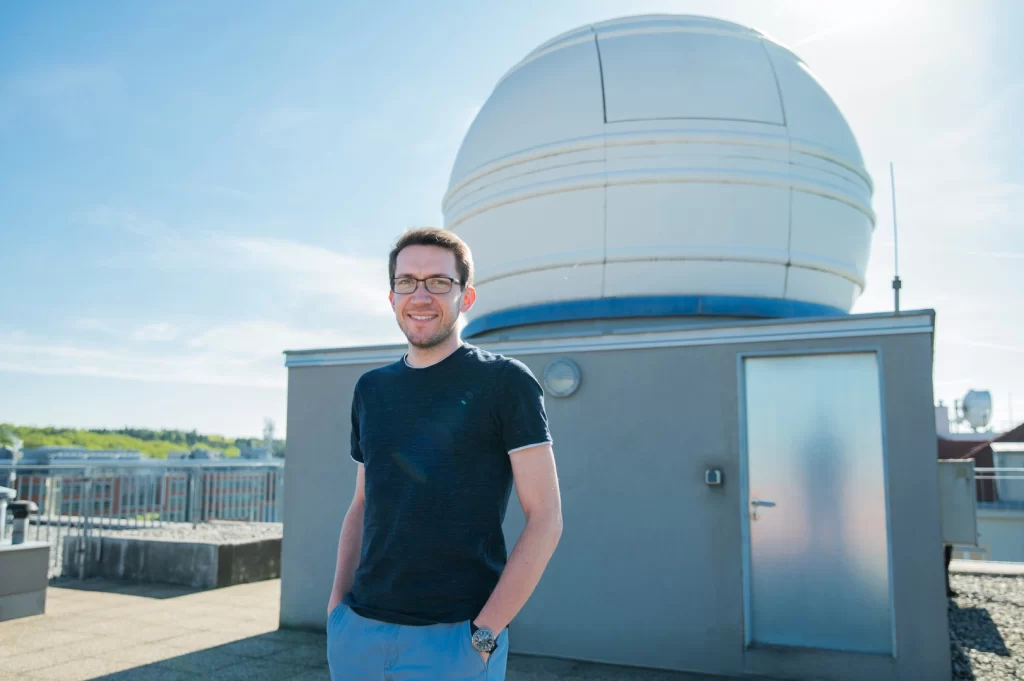
Astrophysicist Václav Pavlík studies stellar remnants and their influence on the evolution of star clusters. He joined the Astronomical Institute of the Czech Academy of Sciences (ASU AV ČR) thanks to the MERIT program from the Central Bohemian Innovation Center. Why can studying star clusters help us understand our place in the universe? How powerful is AI in astronomy, and what do astronomical olympiads offer young people?
You have been studying star clusters and their modeling since the beginning of your scientific career. What is your main focus and goal?
I want to better understand how these systems form—especially globular clusters—and what role black holes or neutron stars play in that process. Simply put, there are two main types of star clusters, which are very different. First, there are relatively young objects called open clusters, where stars are still forming. For example, the Trapezium Cluster, embedded in the Orion Nebula, is estimated to be 2–3 million years old and contains about 3,000 stars. On the opposite end of the spectrum in terms of mass and age are globular clusters, which contain some of the oldest stars in the universe. These may also include groups of stellar black holes or intermediate-mass black holes, about which we still know little. Their typical age is several billion years and they contain millions of stars.
We have a general understanding of how open clusters form, as they are surrounded by gas and material that births stars. But for ancient globular clusters, we don’t know how they originally formed or what they looked like ten billion years ago. That’s a big mystery, especially since we don’t really observe young clusters with millions of stars still forming today.
You mentioned black holes. Do they form in clusters over time, or can they already be present at the time of formation?
Stars form through the accumulation and compression of gas, which heats up and initiates nuclear fusion. Stars that are about 20 times the mass of the Sun evolve into black holes very quickly—within about 10 million years. Since stars don’t form alone but in groups (clusters), black holes can influence their surroundings through gravity. One thing we’re currently studying is whether black holes cause changes in the spatial distribution of stars forming in clusters.
You have been at the Astronomical Institute of the Czech Academy of Sciences since early 2024. Where are you in your research now, and what lies ahead?
A scientific career is a bit deceptive—you’re constantly uncovering new things. Even if you discover something, you usually realize there’s much more you don’t know. So we’re definitely never bored. I’m not sure I can make sweeping judgments about my career yet, even though I have published articles and had some success. In short, I’m doing well at the Institute, there’s still a lot to discover, and I’m motivated to keep going.
What data do you use for theoretical modeling of star clusters?
Right now, we use data from the Hubble Space Telescope and from ground-based observatories, analyzed by my colleague in Italy. In previous studies, we used data from the Gaia mission, and in the future, we plan to include data from the James Webb Space Telescope and gravitational wave detectors. The choice of data depends on which physical aspects of the real systems we want to model.
What are the most common variables or measurements included in your models?
For the simplest simulations, we always need the positions, velocities, and masses of stars. If we want to study the formation and behavior of stellar remnants within clusters, we also need to include stellar evolution. For young clusters, we need information like the percentage of binary stars or the presence of interstellar gas.
In 2020, you went to the U.S. for a postdoc at Indiana University Bloomington. What motivated your move?
I originally didn’t aim for America—I wanted to stay in Europe. But in January 2020, I visited a colleague in Edinburgh who told me her former advisor was looking for a postdoc in the U.S. I applied almost immediately, got an interview a month later, and then got the position.
The U.S. is a space superpower. How would you compare astronomical research in the U.S. and the Czech Republic? Do they have better access to telescope data, for example?
Luckily, most astronomical data is publicly available. So even from Prague, you can access NASA’s data. I can’t compare today’s U.S. with the one I experienced during my postdoc—they’re very different. Back then, research funding was better, and it was a big change from what I knew as a student in the Czech Republic. I was given full trust and autonomy, without excessive oversight. That support system was ideal. I’m happy to say the same kind of supportive environment exists here at the Academy of Sciences.
Financially, of course, the U.S. had more resources. But since I didn’t have my own grant there, I had limited opportunities to travel to conferences. Thanks to MERIT, things are now better for me in Prague in that respect.
Your position at the ASU AV ČR is funded by the MERIT program of the Central Bohemian Innovation Center. How did you learn about MERIT?
My path to MERIT began even before I left for the U.S. Toward the end of my Ph.D. and shortly after my defense, I collaborated with then-director of the Institute, Vladimír Karas. In 2023, he told me about MERIT when I returned to Prague in the summer, and I applied right away. I had to return to the Czech Republic anyway, so while MERIT wasn’t the reason for my return, it gave me strong motivation to stay.
As part of MERIT, you are also doing a placement at the Czech Technical University in Prague, where you are working on integrating AI into your methodology. What future do you see for AI in astronomy?
AI is a big buzzword right now, but it’s actually been used in astronomy for decades—just under the name “machine learning.” The main strength of AI is that it can efficiently process huge datasets. It’s not limited by classical mathematical methods like interpolation and extrapolation—it uses nonlinear algorithms. In some cases, it can even outperform humans in predicting, say, time series. I’m currently getting more familiar with AI at CTU so I can use it in my work, and I’m also advising a student who’s using AI to analyze my models.
You recently won the Jan Frič Award, presented by the ASU AV ČR to young researchers for exceptional achievements. What did you receive it for?
The award is for work published in the last five years that enhances the Institute’s international reputation. I received it for a series of scientific papers on stellar dynamics and the evolution of star clusters. Two of those were published under the MERIT program, and several others reflect my research in the U.S.
Beyond your scientific work, you are also active in popularizing astronomy and educating young astronomers. You are on the Central Committee of the Czech Astronomical Olympiad and an editor for Astropis magazine. How do you manage it all?
When necessary, I spend weekends grading student papers. When we have a magazine deadline, I spend my evenings or weekends writing and typesetting articles. It’s doable, and I’m glad I started—both activities began during my undergrad as meaningful side jobs, and they’re deeply connected. Many people involved in Astropis also help with the Olympiad.
What knowledge should students have to participate in the Olympiad, how many usually take part, and have any become your colleagues?
Since astronomy isn’t well covered in school, most participants are self-taught. Even so, our students perform excellently, with regular success at international olympiads. About 8,000–10,000 kids participate each year. Some have gone on to study at Charles University or join the Academy. Former participants often go into science, IT, medicine, or economics. They all agree the Olympiad helped them tremendously, even if they didn’t pursue astronomy professionally.
You also worked at the Prague Planetarium. What was your role there, and have you applied those experiences in your research?
I was part of the programming team and learned two important things: public speaking and explaining complex topics to laypeople. I used to get nervous speaking, but then I found myself addressing 150 people in a theater. Now, I think I give engaging talks at conferences and can present clearly. I also started translating books thanks to the Planetarium, which advanced my career.
How would you explain the importance of your research to a non-expert?
There are different ways to explain it. Honestly, my research is basic science. It doesn’t have direct industrial applications. But all applied science is built on basic research. My work won’t make bread cheaper—but I try to create solid foundations that can be verified against real observations. Theoretical models of star clusters aren’t abstract—they help plan future missions.
My work can help us understand how the universe formed, how quickly galaxies and star clusters appeared, and ultimately, our place in it. After all, our own Sun formed in a star cluster.
Another way astronomy connects to real life is through its methods. There’s a huge overlap between astronomy and medicine. Techniques from radio and X-ray astronomy are used in analyzing MRI images. Looking for features in MRI scans is much like identifying stars or structures in radio images. This connection has existed for decades, even if it’s not widely talked about.
You mentioned translating books. How many have you done and which ones?
Three so far. First was Star Atlas by Elena Percivaldi, which I co-translated with Jakub Rozehnal (director of the Planetarium). Then I translated Stephen Hawking: A Memoir of Friendship and Physics by Leonard Mlodinow, and The World According to Physics by Jim Al-Khalili. I enjoyed both immensely. I’ve had to decline more offers due to time constraints. After returning from the U.S., I wanted to share my research with a broader audience beyond Astropis, so I wrote two children’s books with Aventinum publishing—one of them is The Disappearing Star, inspired by Betelgeuse.
Would you like to travel to space someday?
I’m torn. My brain says yes, but my stomach remembers it gets sick even on roller coasters—so I’m not sure. I’d love to go, but I’d need someone else to fund it.